
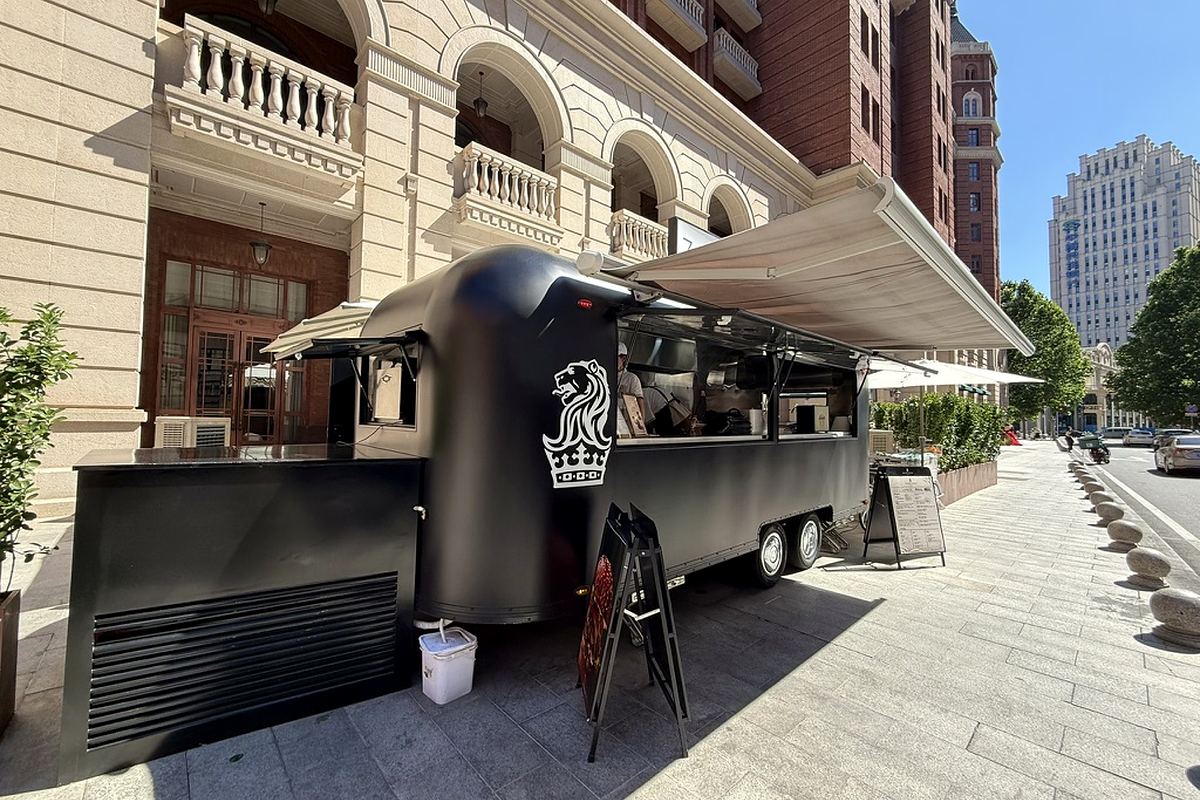
Outside The Ritz-Carlton, Tianjin, the ZEST EXPRESS food trailer has an identity of its own: a rounded black body, a hotel lion emblem, and a serving window where the food meets the street. It gave Cool Toys Trend a specific starting point for a hotel gift. There was already a recognizable object, a reason to approach it, and a small scene unfolding around it.
We developed that scene into the official ZEST EXPRESS Brick Food Trailer Set. The 269-piece product, identified as KWC20610, has been delivered to the hotel. Our work covered the concept, brick design, packaging, illustrated instructions, sampling, production, and photography, alongside planning for how the product could connect with the hotel's dining experience.
The resulting set preserves more than the vehicle. A chef at the window, a server, a menu, food, and café seating give the trailer something to do. For a hospitality team considering custom merchandise, that is the useful part of this project: choosing a piece of the property that guests can recognize through an experience, then carrying that experience into the object they take away.
Begin with a place guests actually encounter
A hotel offers many possible subjects for a miniature. Its façade may be the obvious choice, but a restaurant, service counter, garden feature, or distinctive vehicle can offer a more focused story. The question is which subject has a clear connection to the intended recipient.
Here, the full-size trailer supplied both the silhouette and the context. It belongs to an actual dining setting at the property. A small version can therefore refer to something a visitor has seen and used, rather than requiring a long explanation of the hotel's identity.
That relationship also helps a design team decide what deserves space. The vehicle needs to remain recognizable. The service window needs to read as the center of the action. Food and seating need to explain why someone would spend time there. Each detail can be assessed against a concrete reference instead of an abstract request to make the gift feel luxurious.
Make the small version readable
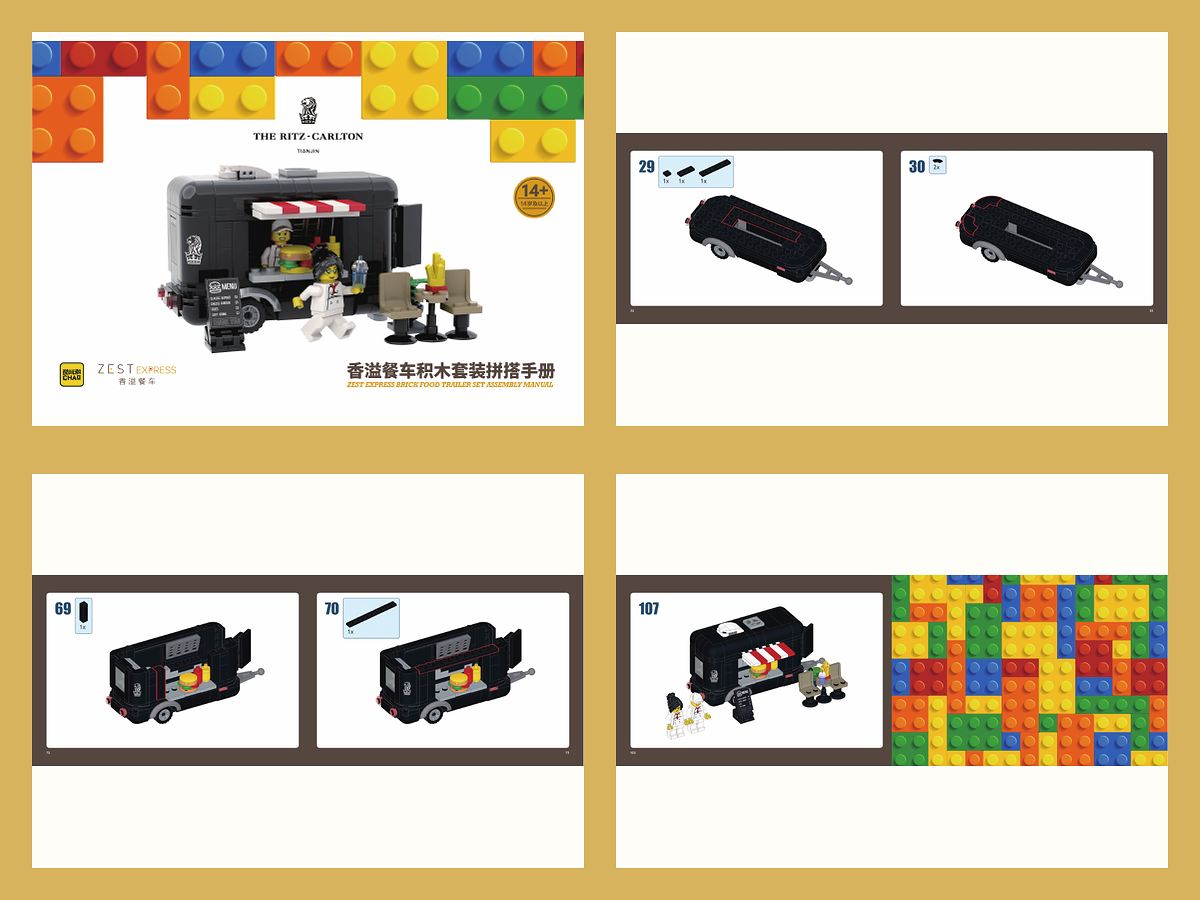
The model retains the dark, rounded vehicle body and adds a red-and-white awning above the counter. The hotel's emblem provides a distinct brand cue. Around it, the burger, fries, drinks, menu board, and furniture create a compact dining scene.
These elements work at different distances. The black body establishes the overall shape. The striped awning draws attention to the serving area. Moving closer reveals the food and the people, turning a vehicle model into a scene that someone can rearrange and examine.
The interior adds another layer. Kitchen equipment and the service counter continue the story inside the trailer. This matters in a building set because the person assembling it encounters spaces and connections that may not be obvious in the final display photograph.
Our interpretation is that this combination gives the model its character: an identifiable exterior, a clear point of interaction, and enough interior detail to reward building. Adding unrelated hotel symbols would have weakened that focus. The useful design constraint was the trailer's own world.
Deliver the box and the build together
The finished model is only part of a custom gift. For this project, the hotel and ZEST EXPRESS identities continue across the packaging and a 53-page illustrated building guide. The box introduces the subject; the instructions take the recipient through assembling it; the completed scene gives the product a place after the build.
Keeping those stages connected was part of Cool Toys Trend's scope. A recipient should be able to recognize the subject on the package, find the information needed to begin, and understand how the parts become the promised scene. Product photography helps communicate that same endpoint before the box is opened.
For another hotel commissioning a set, these are decisions to include in the brief. A finished-model rendering cannot answer every question about the gift. Packaging format, instruction design, presentation, and handoff all need attention during development. They determine what the recipient actually receives, beyond the image approved on a screen.
Connect the keepsake to the dining offer
The hotel's burger-and-building-set package has been introduced, as documented in our updated project record. It creates a direct relationship between the real trailer and its miniature: the dining experience supplies the subject, and the set lets a guest spend more time with that subject through building.
That connection is more specific than placing merchandise somewhere in the lobby and hoping visitors discover it. The product can be explained through the food trailer already in front of the guest. The meal and the model belong to the same setting, while serving different purposes.
This article concerns the delivered product and the documented package launch. Availability and participation terms belong to the hotel's own current communications. We are not reporting package sales or measured changes in guest engagement; those would require separate results. The design lesson is the connection itself, which other hospitality teams can evaluate against their own dining concepts and guest journeys.
Give the same subject a second scale
The project also includes a larger custom brick model created by invited builder 半杯柠檬 (Banbei Ningmeng). That physical build has been completed. Its longer body, multiple service windows, figures, and detailed interior give the food-trailer subject a different role as a display piece.
The small set and the large model should be understood separately. The 269-piece set is the hotel product designed by Cool Toys Trend. The larger original build is the work of Banbei Ningmeng, whom we invited to contribute to the project. The photographs of that work document the completed model, rather than proving that a public event has taken place.
Together, the two scales show how one subject can support different encounters. A display can invite people to look closely; a packaged set can be carried away and assembled. Each needs its own design and presentation decisions. Enlarging a model is not, by itself, an event plan.
What to bring to a hotel merchandise brief
This project began with a recognizable part of the property and ended with a delivered product, packaging, and instructions. Its most transferable lesson is to define the guest's connection to the subject before selecting the format.
For your own brief, identify the place or service you want the object to represent, who will receive it, and how it will reach them. Include reference photographs, approved brand assets, the required quantity, destination, budget range, and arrival date. Explain whether the product belongs to a dining package, a retail offer, a special occasion, or another guest experience. Those details give the design team something useful to work toward.
Explore the ZEST EXPRESS project for the product and packaging, or tell us about your hospitality project. A familiar corner of a property can provide the starting point for a gift with its own story.
Sources
- Cool Toys Trend: The Ritz-Carlton, Tianjin ZEST EXPRESS project, product specifications and development scope.
- 酷玩潮: 天津丽思卡尔顿香溢餐车项目, updated project account covering delivery, the dining package, and the completed model by 半杯柠檬. Reviewed October 15, 2026.


